A Different Way to Look at Change
Turning Insight into Forward Motion and New Possibilities
Check Out Recent Blogs:
-
Why Communication Isn't the Same as Sharing Understanding
-
Change Fatigue is Real!
-
The Invisibility Gap - Good Work Happened
-
What Horses Can Teach Us About Trust
-
Change Maturity and Capability
Upcoming:
-
Firefighters and Fire Preventers
-
Building a Culture Where Good Work Matters
-
Why Do Change Efforts Fail?
-
Ways That Leaders Accidentally Create Resistance
-
How to Know If You're Working in a Toxic Environment
-
Micro-Recognition Is a Business Strategy
Why Communication Isn't the Same as Sharing Understanding
September 28, 2026
Most organizations believe they have a communication problem.
Often, they have an understanding problem.
The email was sent.
The presentation was delivered.
The town hall happened.
The project updates were shared.
Communication occurred.
Yet somehow:
-
People are still confused.
-
Priorities aren't aligned.
-
Resistance emerges.
-
Different teams interpret the same message differently.
-
If communication happened, why didn't understanding follow?
Because communication and understanding are not the same thing.
The Information Trap
Many leaders measure communication by activity:
-
How many emails were sent?
-
How many meetings were held?
-
How many presentations were delivered?
The focus is on transmission.
But understanding isn't measured by what was sent.
It's measured by what was received, interpreted, and acted upon.
People can hear the same message and walk away with completely different conclusions.
Communication asks: Did we tell them?
Understanding asks: Do they know what it means, why it matters, and what happens next?
Those are very different questions.
Why This Matters During Change
I've spent more than thirty years helping organizations navigate change.
One of the most common statements I hear from leaders is:
"We've communicated this several times."
Most of the time, they're right.
The communication happened.
What didn't happen was shared understanding.
Employees were told:
-
What was changing.
-
When it was changing.
-
How it was changing.
But they still wondered:
-
What does this mean for me?
-
Why are we doing this?
-
What problem are we trying to solve?
-
How will success be measured?
Until those questions are answered, understanding remains incomplete.
Understanding Requires Context
Information tells people what happened.
Context helps people understand why it matters.
Without context:
-
Facts become noise.
-
Messages become announcements.
-
Communication becomes a checklist item.
Context transforms information into meaning.
That's where trust begins.
That's where alignment happens.
And that's where change becomes sustainable.
Cookie Culture, Visibility, and Understanding
This same challenge appears in workplace visibility.
People often assume that if the work was completed, others will naturally understand its value.
But that's rarely how organizations work.
A project finishes.
A problem is solved.
A risk is avoided.
A customer issue disappears.
Others see the outcome.
What they don't always see is:
-
what happened,
-
why it mattered,
-
or the value that was created.
The contribution remains invisible because understanding never occurred.
In many ways, the Visibility Gap™ is an understanding gap.
People can't recognize value they don't understand.
A Better Goal
The goal of communication shouldn't be simply to share information.
The goal should be to create shared understanding.
Because understanding creates:
-
alignment
-
trust
-
engagement
-
visibility
-
recognition
-
lasting change
Communication starts the conversation.
Understanding makes the conversation matter.
Closing Thought
The next time you're preparing a message, consider asking a different question.
Instead of:
"How should I communicate this?"
Ask:
"What would people need to understand in order to act on this successfully?"
That shift can make the difference between a message being heard and a message being understood.
Communication transfers information. Understanding transfers meaning
Change Fatigue Is Real: When Transformation Starts to Wear People Down
September 20, 2026
-
Difficulty retaining new information
-
Increased stress and burnout
-
A belief that "this change will be replaced by another one soon anyway"
For leaders, one of the greatest mistakes is interpreting these behaviors as resistance. What may appear to be resistance is often exhaustion.
Why Change Fatigue Happens
Organizations frequently focus on managing individual projects while overlooking the cumulative impact of multiple changes occurring simultaneously.
Employees do not experience change one initiative at a time. They experience all change at once.
A new system implementation may occur at the same time as organizational restructuring, evolving leadership priorities, staffing shortages, policy changes, and increasing business demands. While each initiative may make sense independently, the combined effect can create significant pressure on employees.
People need time to adapt, build confidence, and establish new routines. When change becomes continuous without opportunities for stabilization, fatigue becomes almost inevitable.
The Leadership Connection
One of the most important responsibilities of leadership during times of transformation is managing not only the change itself, but also the human capacity to absorb change.
Leaders who successfully navigate change fatigue focus on:
Prioritization
Not every change can be treated as urgent. Organizations must identify what matters most and avoid overwhelming employees with competing priorities.
Communication
Employees need clarity regarding why change is happening, how initiatives connect to organizational goals, and what is expected of them.
Listening
Leaders who actively listen gain valuable insight into how people are experiencing change on the ground. Surveys, focus groups, one-on-one conversations, and informal check-ins can reveal early signs of fatigue before they become larger problems.
Recognition
Periods of change often require extraordinary effort. Acknowledging progress and celebrating successes helps reinforce commitment and maintain momentum.
Support
Training, coaching, resources, and accessible leadership support can make a significant difference in reducing anxiety and building confidence.
What Horses Can Teach Us About Change Fatigue
At CanterPointe, we often draw leadership lessons from horses because of their extraordinary awareness and sensitivity to their environment.
Horses thrive when there is clarity, consistency, and trust. When exposed to constant uncertainty, conflicting signals, or unrelenting pressure, they become less confident and less responsive.
People are not so different.
Employees perform at their best when they understand expectations, trust leadership, and feel confident in their ability to succeed. Continuous disruption without adequate support can create uncertainty and fatigue. Effective leaders recognize when their teams need time to regain footing, rebuild confidence, and establish stability before moving on to the next challenge.
Building Change Resilience
The answer is not to avoid change. Organizations that refuse to evolve risk falling behind.
The goal is to create an environment where people can successfully navigate change without becoming overwhelmed by it.
This requires thoughtful planning, realistic expectations, empathetic leadership, clear communication, and a genuine commitment to supporting employees through the journey.
When leaders recognize and address change fatigue, they strengthen trust, improve engagement, and increase the likelihood that change efforts will succeed.
Final Thoughts
Change is not slowing down. If anything, the pace of transformation will continue to accelerate. Organizations that thrive will not be those that simply manage more change. They will be the organizations that help people successfully navigate it.
At CanterPointe LLC, we believe lasting transformation occurs when leaders focus on both the change itself and the people experiencing it. Because successful change is not measured by implementation alone. It is measured by adoption, sustainability, and the confidence people have in moving forward together.
Reflection Question: How is your organization measuring the impact of change on people, not just the progress of the project?
The Invisibility Gap
September 10, 2026
Good Work Happened. The Story Never Traveled.
Every organization has it.
The employee who quietly keeps projects moving.
The team member who solves problems before they become crises.
The leader who removes obstacles so others can succeed.
The colleague everyone relies on but few people fully understand.
Their work creates tremendous value.
Yet much of it remains invisible.
I call this the Invisibility Gap™: the space between the value people create and the visibility that value receives.
The challenge is that work today is increasingly difficult to see.
Teams are distributed.
Projects span departments.
Collaboration happens across functions and geographies.
Many of the most important contributions happen behind the scenes.
Ironically, some of the highest-value work is measured by what didn't happen:
-
The deadline that wasn't missed.
-
The customer issue that never escalated.
-
The risk that never materialized.
-
The crisis that never occurred.
When success looks like "nothing happened," recognition becomes difficult.
People cannot appreciate contributions they don't know exist.
This doesn't mean people need to become louder, more self-promotional, or someone they're not.
It simply means helping others understand what happened, why it mattered, and the value that was created.
Because the Invisibility Gap isn't a performance problem.
It's a visibility problem.
And when good work becomes visible, recognition, trust, influence, and opportunity often follow.
Visibility is not vanity. It's how good work gets seen, understood, and appreciated.
What Horses Can Teach Us About Trust
September 3, 2026
Trust is one of the most important, and often misunderstood, elements of leadership.
Organizations talk about it constantly. Teams depend on it. Leaders seek to earn it. Yet trust remains difficult to define and even more difficult to build.
Horses offer a unique perspective.
For thousands of years, horses have survived by accurately assessing the world around them. Their ability to determine what is safe, what is uncertain, and whom to trust has been essential to their survival. As a result, they pay attention to things many humans overlook.
They observe.
They notice.
They respond.
Unlike people, horses are not influenced by titles, credentials, organizational hierarchies, or carefully crafted messages. They simply respond to what is presented in the moment.
That is what makes them such remarkable teachers.
Spending time with horses often reveals how trust is not granted automatically. It develops through experience. It is shaped by what people do rather than what they say. It emerges when actions and intentions align over time.
For leaders, the lesson is both simple and challenging.
Trust cannot be demanded. It cannot be delegated. It cannot be established through authority alone.
Instead, trust is built through the countless interactions that shape how others experience us every day.
This perspective is at the heart of The Horse Wisdom Advantage®—a leadership approach inspired by timeless observations from the natural world and their relevance to today's organizations.
In a business environment increasingly defined by complexity, uncertainty, and change, perhaps some of the most valuable leadership lessons come from stepping outside the boardroom and looking at trust through a different lens.
After all, trust may be one of humanity's oldest challenges. And horses have been helping us understand it for thousands of years.
Great Leaders Move Like Horses
Calm. Aware. Consistent. Connected.
Change Capability and Maturity
August 22, 2026
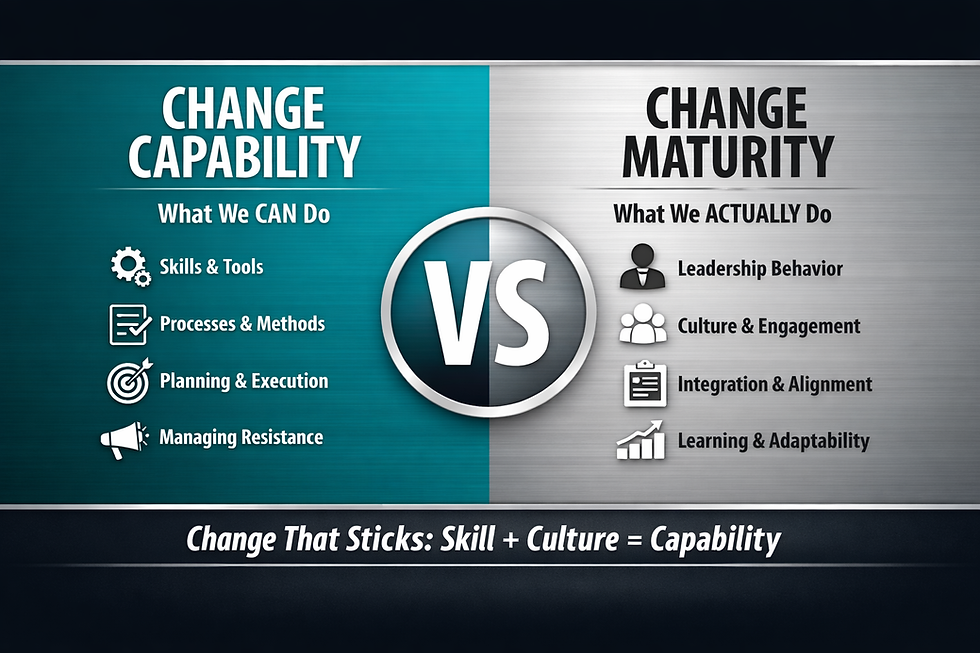
Change Capability vs. Change Maturity: Why Both Matter for a Successful Enterprise
Organizations talk a lot about “managing change,” but very few understand the difference between Change Capability and Change Maturity. They’re related, but they’re not interchangeable, and confusing them is one of the fastest ways companies end up with stalled initiatives, frustrated teams, and leaders who feel like they’re pushing a boulder uphill.
Here’s the simplest way to understand the difference.
Change Capability: What the Organization Can Do
Change capability is the skill set of the enterprise.
It’s the practical, operational ability to plan, lead, and sustain change. Capability answers questions like:
-
Do we have people who know how to lead change?
-
Do we have repeatable methods, tools, and processes?
-
Can we communicate clearly, manage resistance, and support leaders?
-
Can we execute change consistently across teams and functions?
Capability is about competence. It’s the muscle.
Change Maturity: How Well the Organization Actually Does It
Change maturity is the behavioral reality of the enterprise.
It reflects how consistently and effectively the organization uses its capability.
Maturity answers questions like:
-
Do leaders model the behaviors needed for change?
-
Do teams trust the process and engage early?
-
Do we integrate change into strategy, planning, and decision‑making?
-
Do we learn from past change instead of repeating the same mistakes?
Maturity is about habit. It’s the discipline.
An organization can have high capability and low maturity — meaning they could be good at change, but they don’t apply it consistently. This is extremely common.
Why the Difference Matters
Enterprises fail at change not because they lack capability, but because they lack maturity.
Here’s why both matter:
-
Capability without maturity leads to inconsistent execution. You have tools, but no adoption.
-
Maturity without capability leads to enthusiasm but no structure. You have willingness, but no method.
-
High capability + high maturity creates a resilient, adaptive organization that can navigate disruption without chaos.
When both are strong, change stops feeling like an emergency and starts functioning like a core competency.
The Enterprise Advantage
Organizations with strong capability and maturity experience:
-
Faster adoption of new strategies
-
Higher trust between leaders and teams
-
Less resistance and confusion
-
Better alignment across functions
-
More predictable outcomes
-
A culture that sees change as growth, not threat
In other words: they become enterprises that can evolve without losing momentum.
The Bottom Line
Change Capability is what you can do. Change Maturity is what you actually do.
Successful enterprises invest in both, building the skill, then strengthening the habit, until change becomes something the organization doesn’t fear, but leverages.